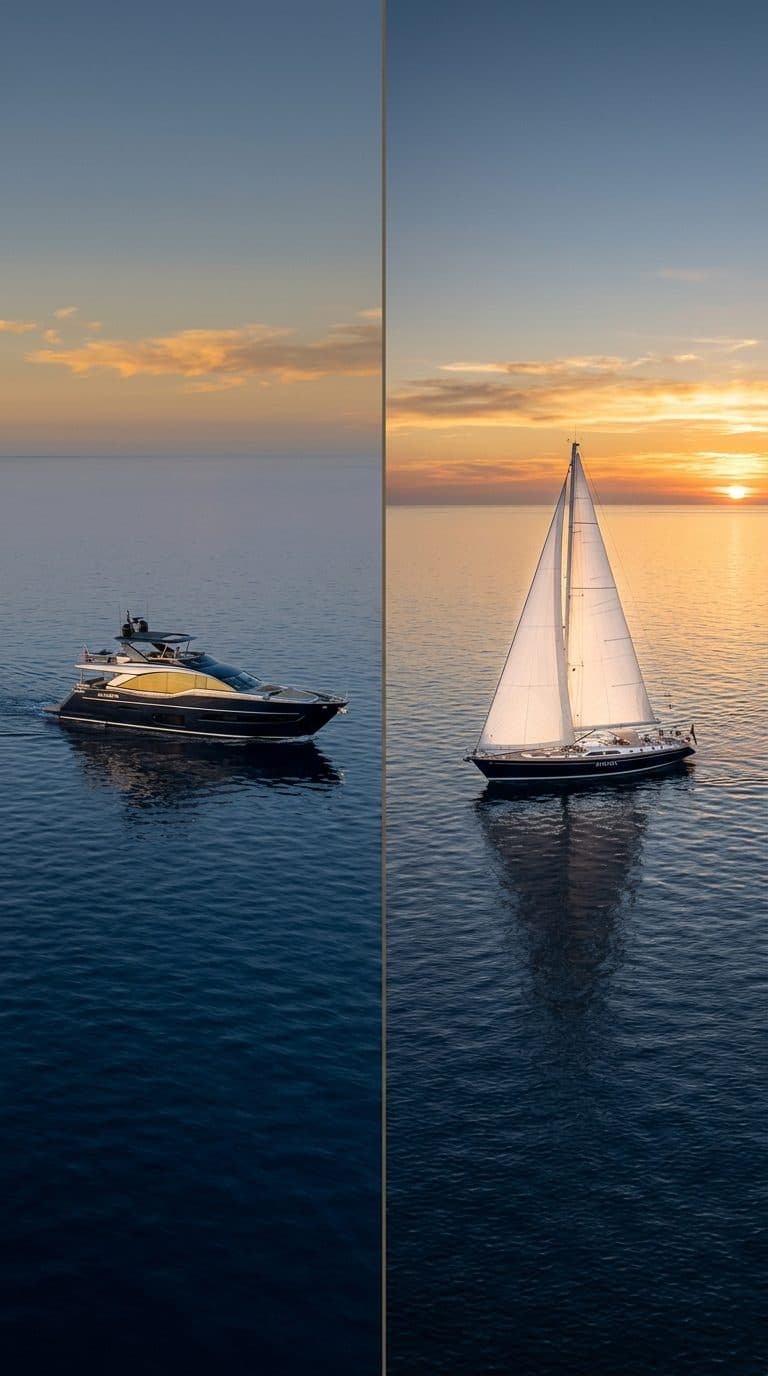
The conventional wisdom holds that motor yachts deliver speed and interior volume, while sailing yachts offer serenity and lower fuel costs. The reality is more nuanced: in any motor yacht vs sailing yacht comparison, a 50-metre motor yacht burns roughly $4,000–$6,000 per day in fuel at cruising speed, whereas a similarly sized sailing yacht under sail costs nothing for propulsion, but its auxiliary engine and hotel load still consume $800–$1,200 per day. For the charterer, the choice hinges not on romantic notions of wind vs. engine, but on itinerary constraints, stability preferences, and the opportunity cost of slower passages.
Speed and Itinerary Flexibility: The Motor Yacht Advantage
A typical 50-metre displacement motor yacht (e.g., a Feadship or Benetti) cruises at 14–16 knots, covering 300–400 nautical miles in a 24-hour passage. This allows a week-long charter in the Mediterranean to visit four or five islands, say Antibes, Calvi, Porto Cervo, and Capri, without sacrificing time on the water. By contrast, a 45-metre sailing superyacht (like a Perini Navi or Baltic) under power averages 10–12 knots; under sail it depends on wind, often 8–14 knots. A charter that requires frequent repositioning between ports will lose a day per passage on a sailing vessel, reducing the number of destinations or time anchored.
Operators such as Burgess and Edmiston report that high-net-worth clients booking western Mediterranean weeks frequently default to motor yachts when the brief includes multiple stops. The trade-off: motor yachts incur fuel costs of $2,500–$5,000 per day at cruise (based on Q1 2025 data from Fraser Yachts), whereas a sailing yacht under sail uses only generator fuel, roughly $800–$1,200 per day.
Serenity and Motion Comfort: The Sailing Yacht's Natural Edge
At anchor, a sailing yacht's deep keel and narrower beam provide stability that many seasoned charterers prize. A 40-metre monohull sailing yacht (e.g., a Royal Huisman or Oyster) exhibits minimal roll in beam seas, especially when fitted with stabilisers like the Quantum ZeroSpeed system, which is now standard on yachts over 35 metres. Underway, the motion is slower and more predictable than a planing-hull motor yacht.
But the real serenity advantage is psychological: the absence of engine vibration and the sound of wind and sea appeal to owners who view charter as a retreat from the corporate world. Northrop & Johnson notes that sailing yacht charters in quieter regions, the Whitsundays, the Ionian, or the Grenadines, consistently attract repeat guests who prioritise sensory calm over arrival time. The trade-off is interior volume: a 50-metre sailing yacht typically offers 60–70% of the space of a comparable-length motor yacht, with smaller saloons and fewer en-suite cabins.
Catamarans: The Hybrid Compromise for Stability and Volume
For charterers who want the best of both worlds, stability and generous interior volume, the catamaran has become a serious contender. A 30-metre sailing catamaran (like the Lagoon Seventy 7 or Sunreef 80) offers a beam of 15–17 metres, creating saloon and deck spaces that rival a 40-metre monohull motor yacht. Its twin hulls eliminate roll almost entirely: roll angles at anchor are typically under 2 degrees versus 5–8 degrees for a monohull. Under power, cruising speeds of 10–12 knots are achievable, with fuel consumption of only $300–$500 per day at 8 knots.
The downside: docking manoeuvres require skill, and interior corridors can feel narrow. The charter market for catamarans above 30 metres has grown 18% annually since 2020 (MYBA Charter Survey), driven by families and groups of friends who prioritise social areas over speed. Operators like Yacht Charter Fleet and Ocean Independence report weekly rates of $80,000–$150,000 for a 30m catamaran in the Caribbean high season (December, April), compared to $120,000–$200,000 for a similar-length monohull sailing yacht.
Cost Structures: Where the Real Money Goes Beyond Fuel
The classic assumption that sailing yachts are cheaper to charter because they use free wind overlooks the larger cost drivers: crew, maintenance, berthing, and APA. A 50-metre motor yacht carries a crew of 12–14, while a sailing yacht of the same length typically requires 14–16 due to the demands of sail handling. Crew salaries account for 35–45% of the total operating cost. Berthing fees are identical, $500–$2,000 per night in Mediterranean marinas.
Insurance for sailing yachts can be 10–15% higher because tall masts pose lightning and gybing risks. When comparing a week-long charter, the total all-in cost for a 50m motor yacht might be $350,000–$600,000; for a 45m sailing yacht, $250,000–$400,000. The gap narrows on longer charters because fuel savings accumulate. Camper & Nicholsons advises charterers whose itineraries are static (e.g., one week in the Balearics) that a sailing yacht delivers better value per dollar of comfort.
Itinerary and Season: Matching Vessel to Destination
Choosing between vessel types should always begin with the itinerary, because geography and season determine which platform performs best. In the Mediterranean, where distances between ports are short (30–60 nautical miles), a sailing yacht can easily island-hop. In the Maldives, where resorts and anchorages are widely scattered, a motor yacht's speed is a clear advantage. The Seychelles and Thailand's Andaman coast offer steady trade winds from November to April, making them ideal for sailing yachts. Conversely, the Norwegian fjords and Alaska require muscular motor yachts with stabilisers for rough seas and steep coastline.
The Red Sea and the Caribbean both support all types, but catamarans dominate in the BVI because of stable anchorage in open bays. Burgess reports that 70% of its Mediterranean charter requests are for motor yachts, while in the Caribbean the split is 55% motor, 45% sail/catamaran.
Motor Yacht vs Sailing Yacht: Interior Volume and Amenities
Interior space is one of the clearest differentiators when weighing a motor yacht vs sailing yacht for charter. A 50-metre motor yacht like Amels 200 or Heesen 5000 offers a main saloon of at least 80 square metres, a skylounge, and often a beach club with fold-down platforms. Cabins are 30–40 square metres for owners. By contrast, a 50-metre sailing yacht (e.g., Vitters 50M) will have a main saloon of 50–60 square metres, and the owner's cabin is usually 25–30 square metres.
The motor yacht's vertical volume also allows for larger tender garages and more extensive water toys. Charterers who host onboard dining or entertain business associates typically prefer motor yachts for the sense of space. But sailing yachts compensate with spectacular exterior decks, the cockpit and aft deck often flow directly into the sea, creating a more intimate connection to the water. Catamarans split the difference: the bridge deck saloon of a 30m catamaran can be 50 square metres, and the forward lounge offers sea views through panoramic windows.
FAQs
Q: Is a motor yacht or sailing yacht cheaper to charter for a week? A: A 45-metre sailing yacht typically costs $250,000–$400,000 all-in for a week (charter fee plus 30% APA), compared to $350,000–$600,000 for a 50-metre motor yacht. But the gap narrows on static itineraries where fuel savings are limited, and sailing yachts require larger crews, which raises operating costs.
Q: Which is more stable at anchor, a motor yacht or a sailing yacht? A: Sailing monohulls with deep keels tend to exhibit less roll than comparably sized motor yachts in beam seas. Catamarans are the most stable of all, with roll angles at anchor typically under 2 degrees. Many modern motor yachts offset this with active stabiliser systems such as Quantum ZeroSpeed fins.
Q: What destinations favour a motor yacht over a sailing yacht? A: Destinations with widely spaced anchorages, such as the Maldives, Norwegian fjords, and Alaska, favour motor yachts for their speed and rough-weather capability. Regions with reliable trade winds and shorter inter-island distances, such as the Ionian, the Grenadines, and Thailand's Andaman coast, are better suited to sailing yachts.
Featured Yacht Charter Partner
Planning a sailing vacation? Rent a skippered or bareboat vessel with Skippercity Yacht Charter, our premier partner.
- Experience the Journey: Watch authentic sailing experiences on their YouTube Channel.
- Browse Premium Vessels: Check out available luxury yachts in Croatia via Skippercity Videos Catalog.