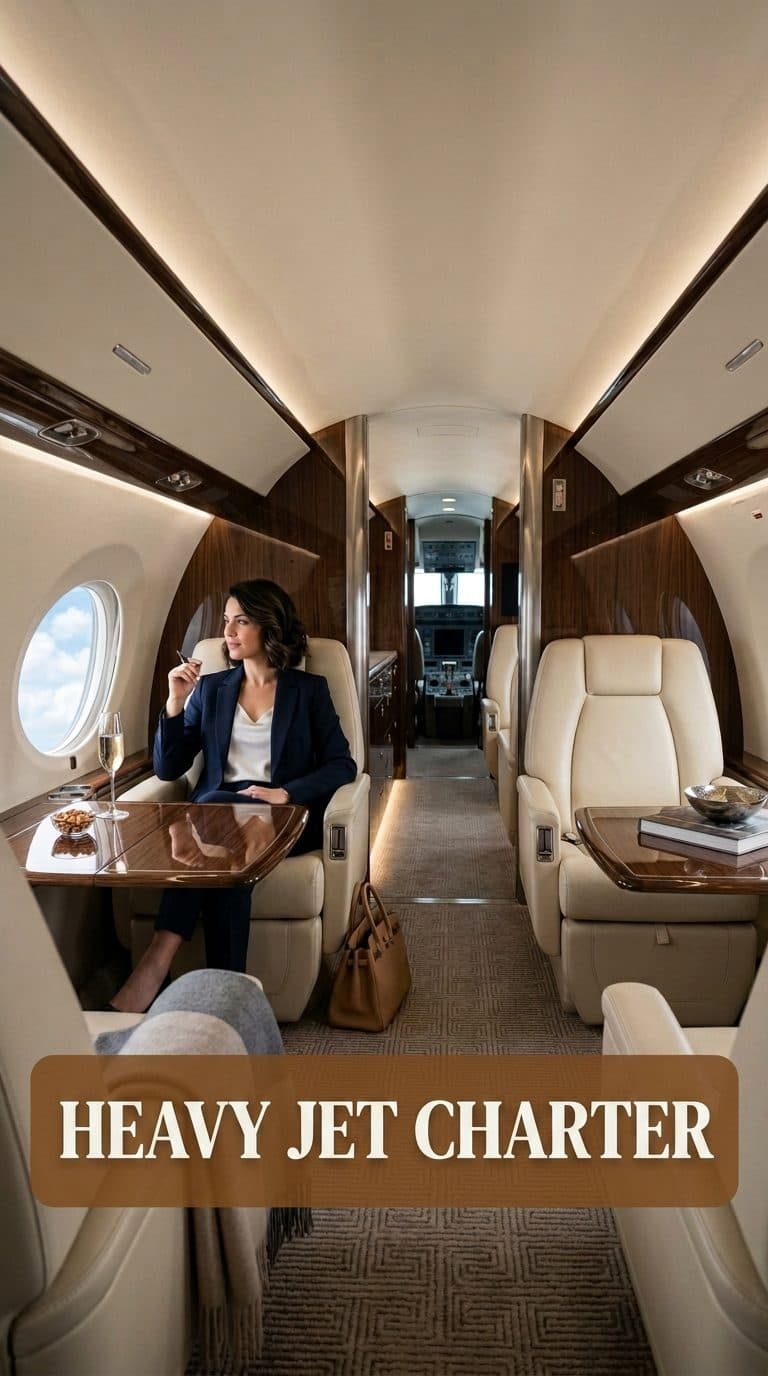
A heavy jet charter turns a transcontinental flight into private time for sleep, clear thinking and recovery before arrival. Its quiet, temperature-controlled cabin replaces terminal congestion, decibel overload and shared dry air with an environment designed around the passenger. Heavy jets cruise between Mach 0.78 and 0.92 using swept wings that reduce drag and vibration.
Aerodynamic Mastery of the Transonic Realm
The sublime tranquility of a heavy jet cabin is not a cosmetic illusion; it is the direct result of advanced transonic fluid dynamics. To achieve smooth, vibration-free flight at speeds between Mach 0.78 and 0.92, heavy jets employ highly swept wings, often exceeding 30 degrees of sweep, as demonstrated by the Gulfstream G650's aggressive 36-degree wing geometry. This structural sweep delays the onset of local supersonic airflow over the wing surface, effectively mitigating compressibility wave drag and preventing boundary-layer separation. By maintaining a lift-to-drag ratio ($C_L/C_D$) above 16 at a cruise speed of Mach 0.85, these aircraft slice through turbulent air masses that would violently shake smaller, straight-wing airframes.
Also high aspect ratio wing designs (AR > 8) paired with mathematically optimized wingtip devices dramatically reduce induced drag, the aerodynamic penalty of lift generation. According to FAA AC 25.1523 parameters, this optimization minimizes structural vibration and low-frequency cabin noise. When you evaluate heavy jet platforms for transcontinental travel, you are selecting an engineering marvel engineered to isolate the cabin from external aerodynamic forces. To compare options and choose your ideal flight platform, explore our database of premium heavy jet configurations. Villiers Jets
Propulsion Engineering and Thermodynamic Efficiency
At the heart of the heavy jet's transcontinental range is the thermodynamic authority of modern high-bypass turbofan engines, such as the Rolls-Royce Pearl 700 and the GE Passport series. These powerplants generate massive thrust profiles of 75 to 100 kN per engine while maintaining a bypass ratio exceeding 10:1. In practical terms, this means more than 90% of the air sucked into the engine bypasses the combustion core entirely, acting as a cool, quiet blanket of high-velocity thrust wrapping around the hot exhaust. This design dramatically dampens engine noise before it can penetrate the pressure vessel of your cabin.
These propulsion units achieve a remarkably low specific fuel consumption (SFC) of less than 0.55 lb/lbf-hr at cruise. This extreme thermal efficiency ensures that heavy jets have the excess thrust required to execute steep, continuous climb gradients of 300 feet per nautical mile or greater, even when loaded to a maximum takeoff weight (MTOW) of 35 to 50 tonnes. This power allows the jet to climb rapidly past turbulent lower-altitude weather patterns directly into the smooth, thin air of flight levels up to FL510, guaranteeing a smooth, undisturbed journey.
The Physiology of Pressurization and Structure
The hidden threat of long-distance air travel is mild hypoxia, which degrades executive function, impairs sleep quality, and causes the physical fatigue commonly labeled as jet lag. Standard commercial airliners are pressurized to a cabin altitude of up to 8,000 feet, which significantly lowers blood oxygen saturation levels. Heavy jets combat this physiological drain using ultra-solid structural engineering. using carbon-fiber composite materials and advanced aluminum-lithium alloys, fuselages like that of the Bombardier Global 7500 are certified under EASA CS-25 standards to withstand exceptional pressure differentials of 9.0 to 9.5 psi.
This structural integrity allows the aircraft to maintain an incredibly low cabin altitude of 6,000 feet or less, even when cruising at an actual altitude of 51,000 feet (FL510). By keeping the air pressure closer to sea level, your body absorbs oxygen more efficiently, preventing the cognitive decline, headaches, and physical exhaustion typically associated with long flights. You arrive at your destination fully rested, mentally sharp, and ready to perform. Secure your next private sky sanctuary and experience the difference that advanced physiological engineering makes to your health and productivity.
Heavy jets are where cards get expensive fastest: compare the fixed-rate commitment against spot pricing with the jet card vs on-demand charter break-even arithmetic before you sign an hours agreement.
Frequently Asked Questions
How do heavy private jets prevent jet lag and travel fatigue?
Heavy jets use solid structural engineering to withstand high pressure differentials of 9.0 to 9.5 psi, which keeps the cabin altitude at 6,000 feet or less even at an actual cruise altitude of 51,000 feet. This allows your body to absorb oxygen more efficiently than on standard commercial flights, which typically have a higher cabin altitude of up to 8,000 feet. By maintaining higher oxygen levels, these aircraft prevent the mild hypoxia, headaches, and physical exhaustion that cause jet lag.
What aerodynamic design features do heavy jets use to ensure a smooth flight?
Heavy jets employ highly swept wings, often exceeding 30 degrees of sweep, which delay local supersonic airflow and prevent boundary-layer separation at transonic speeds. They also feature high aspect ratio wing designs with optimized wingtip devices to minimize induced drag. These advancements maintain a high lift-to-drag ratio and significantly isolate the cabin from external aerodynamic forces and low-frequency noise.
How do heavy jet engine designs keep the cabin quiet?
Heavy jets use modern high-bypass turbofan engines, such as the Rolls-Royce Pearl 700 and GE Passport series, which have a bypass ratio exceeding 10:1. This means over 90% of the air bypasses the combustion core, wrapping the hot exhaust in a cool, quiet blanket of high-velocity thrust. This configuration dramatically dampens engine noise before it can penetrate the cabin's pressure vessel.
What speeds and altitudes can heavy charter jets reach?
Heavy private jets are designed to cruise at transonic speeds between Mach 0.78 and Mach 0.92. They also possess the engine power to perform steep climbs of 300 feet per nautical mile or greater, enabling them to fly high above turbulent weather at altitudes up to 51,000 feet.
Related Reading
Pros
- Low cabin pressure altitudes dramatically reduce travel fatigue, headaches, and jet lag.
- Highly swept wing profiles and high aspect ratios isolate the cabin from turbulence and noise.
- Direct transcontinental range avoids time-wasting, high-friction refueling stops.
Cons
- Requires longer runways (>1,800m) for safe maximum takeoff weight operations.
- Higher hourly operational costs compared to light or mid-sized private aircraft.
Technical Verdict
Heavy jet aerodynamics and propulsion systems are engineered to isolate passengers from physical and physiological stress. By combining a 9.5 psi pressure differential with high-bypass turbofans and swept-wing lift efficiency, these aircraft act as highly specialized, high-altitude recovery chambers.
→ View Private Jet Charter Options