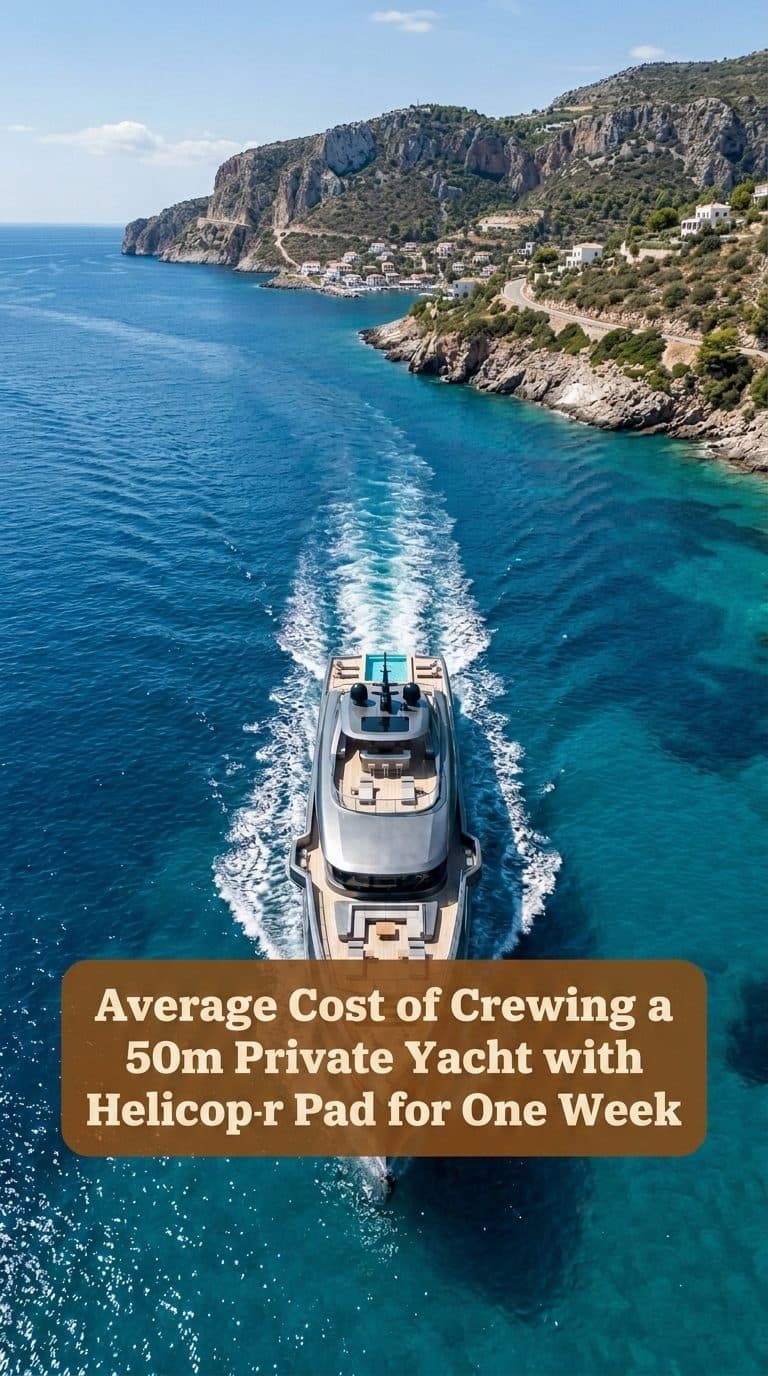
Chartering or operating a 50-meter superyacht represents the pinnacle of bespoke luxury travel. These vessels offer unparalleled privacy, custom itineraries, and world-class service. But adding a helicopter pad to the equation introduces a highly complex layer of logistics, specialized staffing, and regulatory compliance. For high-net-worth individuals evaluating these options, understanding the true cost structure is essential. The average cost of crewing a 50m private yacht with helicopter pad for one week ranges from $300,000 to $500,000, making it a significant financial commitment.
This guide provides an analytical, broker-level breakdown of the capital required to crew and operate a 50m superyacht equipped with a helipad for a single week of charter.
What Does It Cost to Crew a 50m Yacht with a Helipad for a Week?
The average weekly cost to crew a 50m private yacht with a helicopter pad ranges from $300,000 to $500,000, with crew wages accounting for 10-15% of the charter fee. This baseline expense reflects the highly skilled workforce required to safely navigate, maintain, and service a vessel of this scale. When evaluating inventory from elite builders like Feadship, Amels, or Benetti, clients must distinguish between the base charter rate and the operational cash flows managed via the Advanced Provisioning Allowance.
Standard base rates for a high-performance 50m motor yacht typically sit between $250,000 and $400,000 per week. Because the crew's basic salaries are legally contracted on an annual basis, these wages are technically bundled into the yacht's base charter rate. But the operational reality of managing a helipad demands supplemental crew, specialized safety training, and custom insurance riders that quickly drive up the weekly outflow. To secure an elite vessel in prime locations like the French Riviera or St. Barts, you can SamBoat to explore vetted superyachts and direct operator availability.
Breaking Down the Crew Costs
The core staffing budget is dictated by the complexity of the vessel and the standards of maritime safety agencies. A 50m yacht requires a master captain, licensed deck officers, certified marine engineers, an exquisite culinary team, and interior service staff. For a standard week, the direct payroll allocation of these professionals sits between $25,000 and $60,000. This is a fixed expense hidden within your charter agreement, but it remains the single largest component of the yacht's overhead.
Also these figures do not account for discretionary crew gratuities, which are highly customary in the industry. Standard industry practice dictates a tip of 10% to 20% of the base charter fee, delivered to the captain at the end of the voyage. For a 50m vessel, this translates to an additional cash outlay of $25,000 to $80,000, distributed among the crew members who facilitated the journey.
The Helipad Premium Explained
A helipad is not merely a piece of flat deck space; it is a highly regulated aviation facility. To legally land an aircraft like an Airbus H145 or a Bell 429, the deck must comply with international CAP 437 standards. This certification guarantees structural reinforcement, fire-fighting systems, and dedicated monitoring equipment.
Operating this infrastructure requires a designated Helicopter Landing Officer (HLO) and trained fireguards. These crew members command specialized certifications and higher salary tiers. Consequently, yachts possessing functional helipads carry a premium, reflecting both the engineering capital required to maintain the deck and the specialized training of the crew standing by during flight operations.
How Many Crew Members Are on a 50m Yacht with a Helipad?
A 50m yacht typically carries 11-13 crew members, but a helipad adds pilots and specialized staff, increasing the crew count to 13-16. This headcount is strictly regulated by the yacht's flag state administration and the Minimum Safe Manning Certificate. Operating an active heli-deck means the crew cannot simply perform their standard duties; they must be positioned at emergency fire stations during every takeoff and landing.
Total Crew Count: 13-16 Members
 ├── Maritime Operations (5-6)
 │ ├── Captain (1)
 │ ├── First Officer (1)
 │ ├── Chief Engineer (1)
 │ └── Deckhands / HLOs (2-3)
 ├── Interior & Guest Service (5-6)
 │ ├── Chief Stewardess (1)
 │ ├── Stewards / Stewardesses (3-4)
 │ └── Executive Chef (1)
 └── Aviation Division (3-4)
 ├── Primary Helicopter Pilot (1)
 ├── Co-Pilot (1, optional/recommended)
 └── Dedicated Aviation Tech (1)
Typical Crew Positions and Numbers
The standard interior and exterior maritime team handles the day-to-day operation of the vessel. The deck department, consisting of the Captain, First Officer, and two to three deckhands, ensures safe navigation, anchoring, and tender operations. The engineering department, usually a Chief Engineer and a Second Engineer, keeps the generators, watermakers, and propulsion systems functioning smoothly.
The interior department is led by a Chief Stewardess, managing two to three junior stewardesses who deliver seven-star hospitality and housekeeping. An executive chef works alongside a sous chef or crew mess cook to provide bespoke dining experiences for up to 12 guests. This team of 11 to 13 professionals operates in a highly choreographed rhythm to maintain the vessel's pristine standards.
The Extra Crew for Helicopter Operations
When an owner or charterer wishes to keep a helicopter active on board, the crew size must scale up immediately. A helicopter pilot is required, and on long-range flights or complex maritime routes, a co-pilot is highly recommended. These aviators do not double as deckhands; they are dedicated exclusively to flight planning, aircraft maintenance, and piloting.
- Helicopter Landing Officer (HLO): A senior deckhand certified to manage deck safety, communications, and emergency response during landings.
- Aviation Technician: Often required for complex, multi-week charters to perform daily maintenance on aircraft like the Leonardo AW109.
- Fire-Fighting Team: Three deck crew members must be fully geared and standing by with foam cannons during all flight operations.
Weekly Crew Salary Breakdown by Position
Crew salaries on a 50m yacht range from $25,000 to $60,000 per week, with helicopter pilots costing up to $5,000 per day each. These rates reflect the immense responsibility, licensing, and professional experience required of superyacht mariners. The crew of a 50m vessel are career professionals who operate under strict maritime laws, requiring competitive compensation to retain top-tier talent.
Captain and Officers
The Captain of a 50m superyacht holds a Master Unlimited or Master 3000 GT license and carries the ultimate legal responsibility for the vessel, guests, and crew. Their compensation is a direct reflection of this burden, with monthly salaries ranging from $12,000 to $20,000 (translating to roughly $3,000 to $5,000 per week).
The First Officer, who manages the deck crew and acts as the safety officer, commands a monthly salary of $6,000 to $9,000. These officers oversee the safety protocols of the helipad, ensuring all crew members are drilled in emergency aviation procedures.
Engineers and Deckhands
The Chief Engineer is arguably the most critical crew member on board, responsible for the millions of dollars of mechanical infrastructure. A qualified Chief Engineer on a 50m vessel earns between $9,000 and $14,000 per month.
Deckhands, who handle the physical labor of maintaining the exterior, polishing the hull, and launching tenders, earn a entry-to-mid-level deckhand salary of $3,000 to $4,500 per month. Those with specialized qualifications, such as diving instructors or certified HLOs, command salaries at the higher end of this range.
Stewards and Chef
The culinary experience on a superyacht is central to the charter. An executive chef on a 50m yacht, often trained in Michelin-starred restaurants, commands a monthly salary of $7,000 to $11,000.
The interior service is driven by the chief stewardess salary, which ranges from $6,000 to $9,000 per month. Under her direction, junior stewardesses earn between $3,000 and $4,500 per month, maintaining impeccable interior standards and providing round-the-clock silver service to the guests.
Helicopter Pilots and Crew
A rotary-wing pilot qualified for maritime landings represents a highly specialized labor cost. Because of the extreme risk of landing on a rolling, pitching deck, these pilots must maintain instrument ratings and extensive deck-landing logs.
A freelance maritime helicopter pilot costs between $3,000 and $5,000 per day (roughly $21,000 to $35,000 per week). If the helicopter is leased with the pilot, this cost is wrapped into an aviation charter contract, but the daily professional fee remains a prominent line item on the invoice.
What Is the Helipad Premium on a 50m Yacht Charter?
Chartering a yacht with a helipad typically costs 10-20% more than a similar yacht without one, plus $2,000-$5,000 per flight hour for helicopter operations. This premium accounts for the structural engineering of the vessel, specialized insurance coverages, and the intensive training required of the maritime crew. In the 50m range, a helipad is a rare and prestigious feature, often found on custom builds from elite yards like Lürssen, Heesen, or Oceanco.
The Cost of a Helipad-Equipped Yacht
Designing a yacht to handle helicopter operations requires significant structural reinforcing. The deck must withstand the dynamic landing loads of a multi-ton aircraft, demanding heavy steel framing or high-grade aluminum reinforcements beneath the teak. Also safety regulations require recessed tie-down points, flush lighting, folding safety nets, and specialized drainage systems to contain fuel spills.
These capital investments drive up the initial build cost of the vessel, which operators pass on to charterers. A standard 50m motor yacht might charter for $280,000 per week, whereas an identical-sized sister ship with a fully certified commercial helideck will easily command $320,000 to $350,000 per week.
Additional Helicopter Operating Costs
The helicopter itself is rarely included in the base yacht charter rate. Charterers must either bring their own aircraft, lease one from a regional operator, or rent a machine through their yacht broker (such as Burgess Yachts or Fraser Yachts).
- Dry/Wet Lease Rates: Leasing a light twin-engine helicopter (such as an Airbus H135) costs $15,000 to $30,000 per week.
- Flight Hour Charges: Direct operating costs, including turbine fuel and engine maintenance programs, run $2,000 to $5,000 per flight hour.
- Aviation Insurance: Marine aviation hull and liability insurance can add $5,000 to $10,000 to the weekly charter policy.
- Positioning Flights: Charging for the flight hours required to fly the helicopter from its land base to the yacht's position at sea.
How the APA Covers Crew Costs and Other Operational Expenses
The Advanced Provisioning Allowance (APA) is typically 20-30% of the charter fee and covers fuel, dockage, provision, and helicopter operating costs, but not crew wages. The APA acts as a simple expense account. Prior to stepping on board, the charterer deposits this sum with the yacht broker. The captain manages these funds during the voyage, presenting a fully audited receipt log at the conclusion of the charter.
"The APA is the standard financial mechanism used in luxury yacht charters to isolate variable operational overheads from the vessel's fixed hire costs, ensuring the guest only pays for what they consume."
What Is APA?
The APA is an essential administrative tool designed to give the charterer complete flexibility over their itinerary and consumption. Because it is impossible to predict how much fuel will be consumed or how many bottles of vintage champagne will be uncorked, the APA acts as a flexible fund. Typically, the APA is set at 20-30% of the base charter fee, and any unused portion is refunded to the charterer after the voyage. This mechanism ensures that crew-related expenses such as provisioning, dockage, and helicopter fuel are covered transparently, while crew wages remain a separate contractual matter.
Total Estimated Weekly Budget for a 50m Yacht with Helipad
Factoring in all components, base charter, crew wages, helicopter operations, APA, and incidentals, the total weekly budget for a 50m yacht with helipad typically ranges from $300,000 to $500,000. This comprehensive figure allows high-net-worth travelers to plan their luxury maritime experience with confidence. Compared to a private jet charter, which can cost $150,000 to $300,000 for a week of dedicated long-range travel, a 50m yacht with helipad offers a unique combination of accommodation and aviation capability, making it a premium option for those seeking the ultimate in flexibility and privacy.
Seasonal variations also play a role, with peak Mediterranean summer charters commanding higher rates than off-peak Caribbean winter seasons. For example, a week in July on the French Riviera can add 10-20% to the base rate compared to a similar week in November in the Bahamas. Also destinations like St. Barts and Antigua are popular during the winter holidays, with premium pricing reflecting demand. For US-based travelers, departing from Miami or Fort Lauderdale can reduce positioning costs for the yacht and helicopter alike.
FAQs
How much does it cost to charter a 50m yacht with a helipad for one week?
The total average cost ranges from $300,000 to $500,000 per week, including base charter, crew wages, APA, and helicopter operations.
Are helicopter pilot costs included in the yacht charter fee?
No, helicopter pilot costs are typically separate, ranging from $3,000 to $5,000 per day, and are often covered under the APA or an additional aviation contract.
What does the APA cover?
APA covers variable operational expenses such as fuel, dockage, provisioning, and helicopter operating costs, but not fixed crew wages.
For more insights on luxury travel, explore our guides on private jet charters and crew etiquette.
Crew cost is not the only line that moves with the vessel: the wellness and spa superyachts that carry a full spa team price differently again. Before you commit to a vessel or a rate, check the deck itself: the superyacht helipad specifications and CAP 437 requirements page sets out what a certified helideck has to carry, from firefighting and tie-down points to the HLO requirement.