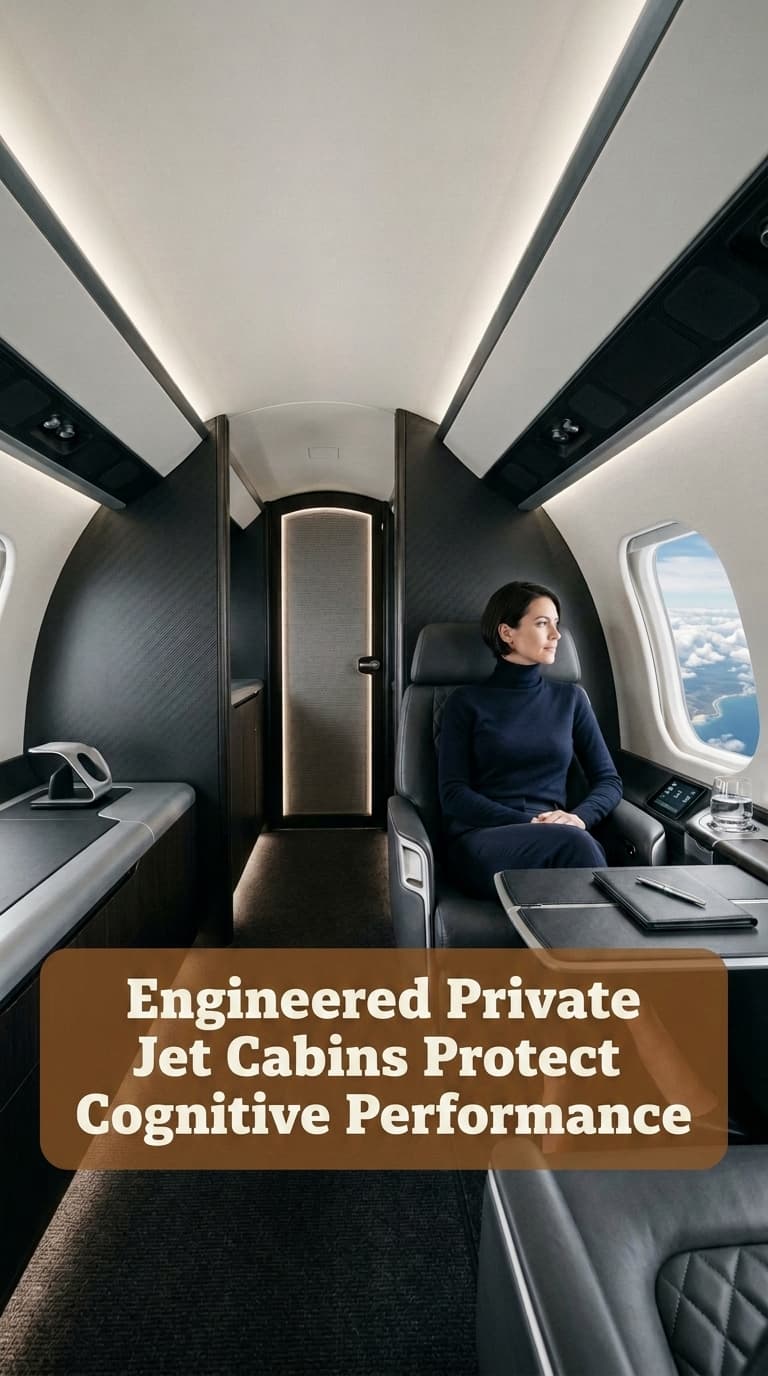
The modern commercial first-class cabin is marketed as a pinnacle of luxury, yet it remains a gilded cage bound by the rigid, chaotic realities of commercial aviation infrastructure. For high-stakes decision-makers, true luxury is not defined by champagne or seat width; it is defined by cognitive preservation, physiological sovereignty, and the absolute elimination of systemic friction. When you step into a private heavy jet cabin, you are not merely purchasing a flight; you are entering an engineered sanctuary designed to insulate your nervous system from the physiological taxing of travel. This is the ultimate home-away-from-home sanctuary: a quiet, pressurized, highly controlled micro-environment where stress dissipates, deep sleep is effortlessly preserved, and your cognitive performance remains entirely uncompromised. To fully understand the value of this lifestyle upgrade, one must look past the aesthetic allure and analyze the cold, hard physics of time-value compression, fluid dynamics, and human physiology.
The Time-Value Gradient: Quantifying the Premium of Mach 0.925
To quantify the true value of VIP jet rentals, we must establish a rigorous framework for the time-value gradient of executive capital. Commercial travel forces passengers through a highly inefficient hub-and-spoke distribution model, introducing severe routing penalties and dead-time overhead. For a typical multi-city trip, a commercial itinerary includes check-in buffers, security processing, baggage handling, boarding delays, and hub layovers, totaling an average of 3.5 to 5 non-productive hours per flight leg.
In contrast, operating a high-velocity private aircraft like the Gulfstream G700 at its high-speed cruise of Mach 0.925 fundamentally alters this equation. By bypassing commercial hubs and using point-to-point routing directly to secondary and tertiary airports, private aviation compresses total travel time by over 60%. For an executive whose time is valued at $10,000 per hour, a 4-hour reduction in transit latency yields a direct capital preservation of $40,000 per leg. When evaluating your flight options, selecting the right platform is critical to unlocking these compounding time savings. Villiers Jets
This time-value compression is not linear; it follows a power-law distribution. The cognitive bandwidth saved by eliminating airport crowds, long lines, and boarding stress directly translates into peak executive output. Instead of recovering from the journey, you arrive at your destination fully entrained, prepared, and ready to execute high-value transactions.
Stochastic Delay Mitigation and Schedule Invariance
Commercial aviation networks operate as highly coupled, complex systems vulnerable to cascading failures. A single delay at an airport hub like Chicago O'Hare or London Heathrow propagates through the entire network, causing downstream cancellations due to crew flight-time limits or gate congestion. This system behaves according to Poisson-distributed arrivals, where the probability of a multi-leg commercial trip completing without delay decays exponentially with each additional connection.
Private aviation achieves schedule invariance by decoupling your itinerary from these fragile commercial networks. Operating under Part 135 regulations, private charter flights enjoy dynamic routing and real-time flight plan modifications. If air traffic control reports a bottleneck at a primary airport, a private crew can smoothly divert to a nearby executive airport within minutes. This operational agility transforms travel from a chaotic, probabilistic gamble into a deterministic certainty, protecting critical corporate timelines and ensuring absolute schedule reliability.
Psychophysical Thresholds: Cabin Pressure and Circadian Preservation
The physical toll of long-haul travel is primarily a function of altitude-induced hypoxia, low relative humidity, and acoustic fatigue. Commercial airliners are typically pressurized to a cabin altitude of 8,000 feet. At this pressure, the partial pressure of oxygen ($P_{O_2}$) in the blood drops, leading to mild systemic hypoxia. This manifests as headaches, cognitive lethargy, elevated heart rate, and severe jet lag. Also commercial cabins often operate at relative humidity levels below 10%, causing mucosal dehydration and suppressing immune function.
Premium private aircraft address these physiological stressors through advanced environmental control systems. By using lower cabin pressure ceilings, often maintaining a cabin altitude of just 3,000 to 6,000 feet even at a cruise altitude of FL510, blood oxygen saturation remains near sea-level baselines. Also advanced humidification systems maintain relative humidity at a comfortable 20-25%, preventing dehydration. For those seeking the absolute pinnacle of physiological preservation, selecting an aircraft with an optimized environmental control system is essential. PrivateJetFinder
Acoustic design also plays an incredibly vital role in cognitive preservation. While commercial cabins frequently subject passengers to continuous low-frequency noise levels of 75 to 85 dBA, high-end private jets use active noise-reduction technologies and advanced insulation to lower cabin noise to below 50 dBA. This whisper-quiet environment prevents sensory fatigue, enabling deep, restorative sleep and uninterrupted cognitive focus during your flight.
Thermodynamic Efficiency of Dedicated Point-to-Point Routing
Critics of private aviation often point to localized fuel burn metrics without examining the broader thermodynamic efficiency of the entire travel lifecycle. When a commercial airliner sits idling on a taxiway for 45 minutes due to terminal congestion, or circles in a holding pattern for an hour due to runway queue limitations, it wastes thousands of pounds of fuel while generating zero economic utility for its passengers.
Private aircraft bypass these systemic bottlenecks entirely. Because they can access over ten times the number of airports available to commercial carriers, they rarely experience taxiway delays or holding patterns. They climb faster and cruise at higher altitudes (typically FL450 to FL510), far above the congested commercial air traffic lanes of FL310 to FL390. This cleaner aerodynamic environment allows for optimal fuel burn profiles, converting thermal energy directly into forward velocity rather than wasting it in holding patterns.
Capital as Exposure Hedging: The Option Value of Instantaneous Deployment
In modern global markets, capital efficiency is highly dependent on geographic agility. The ability to deploy a specialized team of executives, engineers, or negotiators to a critical site within hours is a massive strategic advantage. In financial terms, private jet rental is not a luxury expense; it is a highly valuable call option on unexpected market opportunities.
When you maintain immediate access to private aviation, you secure the right, but not the obligation, to execute rapid geographic arbitrage. Whether it is responding to a critical supply chain failure, securing a distressed asset before competitors can mobilize, or personally closing a multi-billion dollar deal, the speed of your response determines the outcome. By removing the friction of commercial scheduling, you transform your executive team into an agile, highly responsive asset capable of capturing asymmetric returns globally. To establish this operational capability and guarantee your flight readiness, secure your on-demand jet charter solutions today.
Related Reading
Pros
- Eliminates hub-and-spoke transit delays and security terminal queues.
- Lower cabin altitudes preserve blood oxygenation and minimize jet lag.
- Offers complete operational privacy and secure communications in-flight.
Cons
- Requires higher initial capital outlay compared to commercial first-class.
- Subject to localized weather delays, though highly mitigated by dynamic routing.
Technical Verdict
Private aviation shifts the travel equation from a costly time-sink to a high-return operational lever. By combining aerodynamic speed with optimized cabin pressures, it preserves both your executive timeline and your physiological well-being.
→ View Specs & Pricing